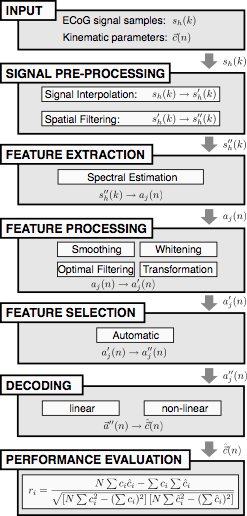
Once we determined the brain signal responses corresponding to directional orientation (i.e., directional attention and intention), we will construct appropriate computational models (e.g., such as the procedure illustrated on the right) that can reconstruct (i.e., decode) the relevant task-related parameters. Such parameters include, for example, the horizontal and vertical position of directional attention or of eye movements. The eventual use of such information would be the optimization of communication presented to a person, e.g., presenting visual information to that person in the area of maximum attention.
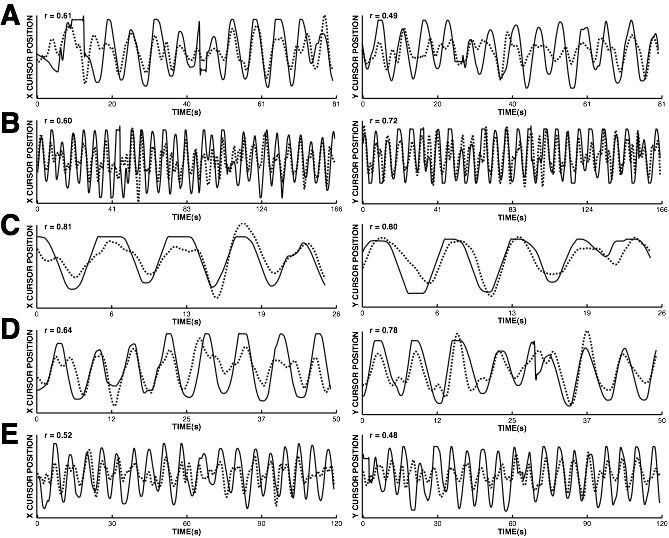
One related example from a previous project is shown in the figure below. In this study, we decoded the position and velocity of a person’s hand movements using brain signals in humans. This figure shows in actual (solid) and decoded (dashed) traces the horizontal (left) or vertical (right) hand position in five subjects (A-E). It is evident that the decoded hand position is generally in good congruence with the actual hand position. See Schalk et al., Journal of Neural Engineering, 4:264-275, 2007, for more information.