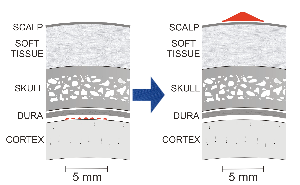
Our eventual goal is to construct a system that can determine directional orientation in real-time and non-invasively. To optimize the performance of this system, we will first determine those brain signal responses that are relevant to directional orientation using signals recorded from the surface of the brain. These signals are recorded in people with epilepsy who have electrodes implanted for clinical purposes (i.e., to determine the focus of the seizures). We will then use the information gained from these recordings to optimize the detection of these responses non-invasively.
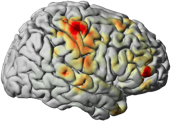
One example of such information from a previous study is shown in the figure on the right. This figure shows in color the amount of information about the direction of hand movements that is captured in different areas of the brain. Most of the information is concentrated in traditional hand motor cortical areas. See Schalk et al., Journal of Neural Engineering, 4:264-275, 2007, for more information.
The first step in this project is to determine the information that is encoded in the brain about directional attention and intention. The brain uses attention for:
- Alerting, orienting, executive control
- Enhances processing of sensory information at particular locations in space
- Allows us to detect events in the world faster and more accurately
In contrast, the brain uses intention for:
- Selective enhancement depending on which action is specified, i.e., specific movement plans
- Anatomical specialization containing spatial maps of intentions
- Carrying information for movements in different coordinate systems